critical study of literature (Year 11)
📍 What's on this page

“Criticism is more creative than creation... and the highest criticism is that which reveals in the work of Art what the artist had not put there.” - Oscar Wilde
Welcome to your final English Advanced module for Year 11 — the deep dive into a major literary text where you learn to think, read and write like a critic.
What it’s all about
This module asks you to take a deep dive into why a major literary text still matters — how it expresses ideas, values and attitudes that continue to resonate today. You’ll examine:
How the author uses structure, language and form
How context shapes meaning
How readers across time interpret the same text differently
What makes a text aesthetically powerful and enduring
By the end, you’ll be crafting informed, confident interpretations backed by evidence and critical thinking.
Some Key Things to Keep in Mind
Texts don’t exist in a vacuum. Remember that no text exists in a vacuum. Every work of literature is part of a bigger conversation
Writers borrow, twist and reinvent. Your text is shaped by what came before — and shapes what comes after.
Tropes and conventions matter. Notice when a text follows genre rules and when it breaks them.
Beauty has purpose. Ask how style, voice and aesthetic choices strengthen (or complicate) meaning.
How to Approach a “Critical Study of Literature”
1. Start with your own reading
Make judgments about the text’s ideas, style and impact. Don’t shy away from how you feel initially about it, after all, it is your unique interpretation that is what makes your responses interesting!
2. Build a sophisticated argument
Develop your interpretation into a clear thesis about the text’s meaning and value.
3. Test and refine your ideas
Don't work entirely alone. Discuss your perspectives and arguments with peers to see if they hold up under scrutiny.
4. Targeted Practice
Select key passages, specific moments, or pivotal characters and practice a kind of "micro-analysis" that supports your overarching thesis. Write a paragraph or two on one of these specific moments. Putting your ideas on the page is a kind of thinking, one which allows you to get out your ideas in a no-pressure space and see if they hold up and are worth pursuing.
5. Analyse form, language and structure
Form: How does the text type shape meaning?
Language: What techniques create voice, tone or symbolism?
Structure: How does the arrangement of events or ideas reinforce themes?
6. Look beyond the text
High‑level analysis requires context:
Reception: How was the text understood then vs now?
Critical perspectives: Engage with other scholars’ interpretations.
Cultural frameworks: Especially for Aboriginal and Torres Strait Islander texts, consider community, voice and cultural knowledge.
Your context: How do your values shape your reading?
want more detail?
(and a complete support guide for your hsc exams today?)
The Band 6 Formula: What the Rubric Really Means
Some tips for success:
Sustain your argument. Every paragraph should link back to your central thesis. Avoid only listing techniques; instead, explain how those techniques contribute to the text's enduring value.
Read widely. Supplement your core text with wider reading. You’ll need this to compare your text to others in its genre or period.
Ask “So what?” When you identify a feature of language or form, always ask: Why does this matter to the text’s meaning? Answering this is the key to a truly "critical" analysis.
Take note of what specific language is used in the rubric to give you an idea of what to aim for:
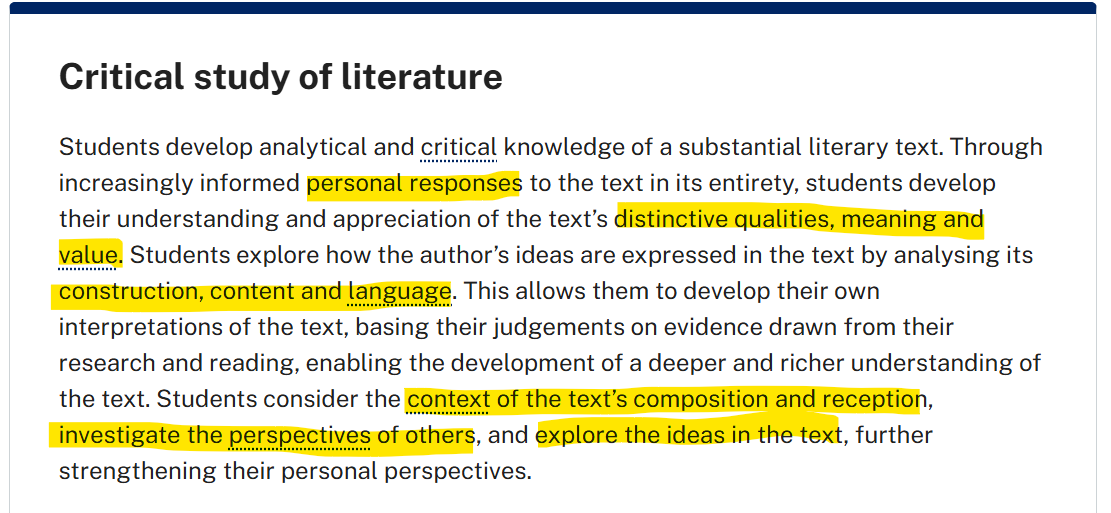
Mastering the Module
Step 1: Understanding the Text
Look beyond the plot. Focus on themes, ideas and aesthetic choices.
Try creating a Technique‑to‑Theme map. For every major theme, find three specific "aesthetic" moments (metaphors, motifs, or structures) that bring it to life.
Explore context. Research at least two specific historical events or social values from the author's time. How do these show up in the characters' motivations?
Analyse form and genre.
Identify where the text follows conventions — and where it breaks them for effect. Note one place where the author follows the rules and one where they appear to break them. Is this done just to keep the audience on their toes, or is there a deeper meaning?.
Discover the power of language.
Consider how specific word choices (high modality, emotive language) change the meaning for different audiences. Find a key speech or passage. If you changed the "register" from formal to informal, how would it change the character’s power or the audience's sympathy?
step 2: Responding Like a Pro
Build an informed personal response.
Use evidence and critical perspectives to support your interpretation.
Phrases like “A feminist/historical reading highlights…” show that you’ve considered multiple viewpoints.
Master the "Sustained" Argument.
A high-band essay doesn't just list points; it builds a single, strong argument from start to finish. Practice ‘Thesis Linking’: Every topic sentence in your body paragraphs should use a keyword from your main thesis to keep your argument focused.
Adapt your voice.
You may need to write creatively or reflectively. Try rewriting a scene from a different character’s perspective to understand voice and form.
Use literary metalanguage.
Swap vague phrasing for precise terms:
appropriation, intertextuality, modality, motif, narrative framing, etc.
You’ve reached the end of the guide — but this module is all about returning, rereading and refining. Come back to these ideas whenever you need a boost, and you’ll be well on your way to mastering critical analysis.