narratives that shape our world
📍 What's on this page
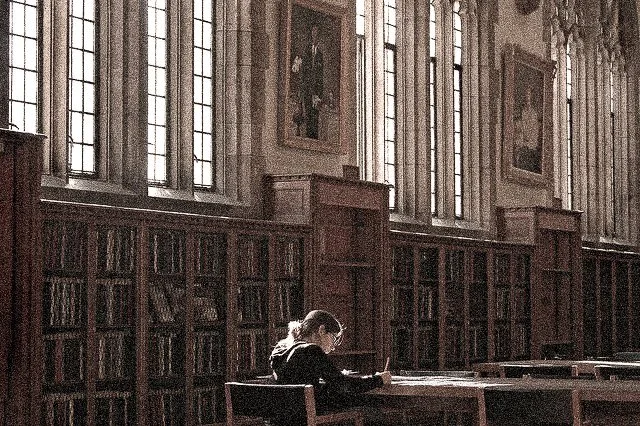
“The universe is made of stories, not of atoms.” - Muriel Rukeyser
Narratives That Shape Our World: A Quick Guide for English Advanced
Welcome to your streamlined guide to the Narratives That Shape Our World module. This is where you’ll explore how stories travel across time, cultures and mediums — and how they continue shaping the way we see the world today.
What it’s all about
This module asks you to examine how a single narrative can be retold, reshaped and reimagined across different eras and contexts. You’ll look at:
How stories shift when told through different forms and mediums
How historical, social and cultural contexts influence meaning
How authors and audiences shape — and reshape — a narrative
How intertextuality and allusion connect texts across time
Think of a story like Robin Hood: across different iterations and mediums the core narrative stays familiar, but every retelling reflects the values, concerns and creativity of its moment.
You’ll also explore Indigenous and Torres Strait Islander narratives, considering how their forms, perspectives and storytelling traditions offer alternative ways of understanding story, culture and identity.
How to Explore the “Narratives That Shape our World”
You’ll respond through both critical and creative writing.
Critical responses
Use comparative language to analyse how narratives change — and what stays the same. Focus on:
Composer context: What shaped the original text?
Your context: How do your values influence your reading?
Audience reception: How might different eras interpret the same story?
Creative responses
Experiment with how form, style and medium influence meaning. Try reimagining a familiar narrative in a new context, or compare how the same story works in a poem vs a film.
Tip: To brainstorm for this, you might do a comparative study of your prescribed texts. Take a single story, (e.g. Robin Hood) and compare how it appears in two different mediums (e.g a poem vs a film). Create a Venn diagram to visualise what remains the same and what changes due to the medium’s constraints or strengths. For example, how might a film’s camera angle achieve what a novel does with internal monologue?
Remember, your unique perspective matters, and your interpretation is part of the ongoing conversation.
want more detail?
(and a complete support guide for your hsc exams today?)
The Band 6 Formula: What the Rubric Really Means
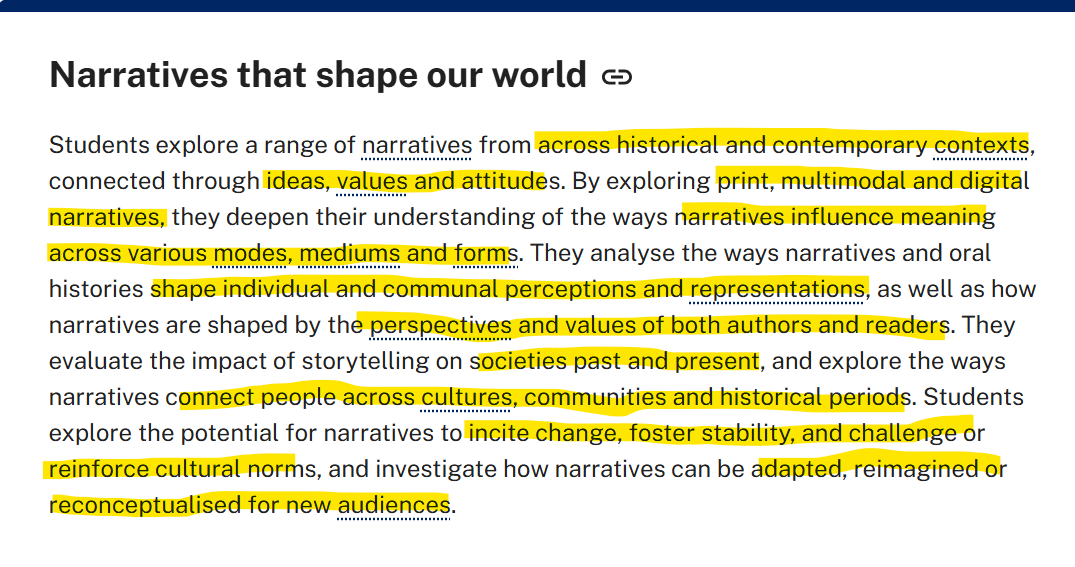
The rubric centres on three key ideas:
1. Compare and Contrast
Look at how ideas, values and attitudes shift across mediums, contexts and cultures. Meaning is shaped by how a certain culture might choose to present them.
2. Context Shapes Meaning
Narratives evolve because societies evolve. Consider how language, form and technique change over time — and why.
3. Stories Do More Than Entertain
Narratives can challenge assumptions, preserve traditions, critique power or amplify silenced voices. Pay attention to the purpose behind each retelling.
Mastering the Module
To show strong understanding, focus on:
Intertextual Connections
Find clear references to other literature, myths, or historical events. Classify these as explicit (direct quotes/references) and implicit (stylistic imitation or shared archetypes).
Purpose of Adaptation
Ask why a composer reimagines a story:
Does it reinforce the original message? Challenge it? Subvert it?
Indigenous Perspectives
Explore how Indigenous storytelling traditions differ from Western linear narratives. Consider whose voices dominate — and whose are missing.
Use Metalanguage
Terms like intertextuality, appropriation, allusion, metafiction and reimagining help you write with precision and confidence.
Try Reimagining a Narrative Yourself
Adapting a classic story into a modern context is one of the best ways to demonstrate your understanding of how narratives evolve.
That’s your snapshot of the module. Revisit these ideas whenever you need a refresher — and enjoy discovering how stories continue to shape the world around us.