reading to write
📍 What's on this page

“Read, read, read. Read everything — trash, classics, good and bad, and see how they do it." "Just like a carpenter who works as an apprentice and studies the master." "Read! You'll absorb it. Then write.” - William Faulkner
Reading to Write: Your Guide to Transitioning into English Advanced
Welcome to your quickfire guide to the Reading to Write: Transition to English Advanced module — what it is, why it matters, and how to absolutely thrive in it.
What it’s all about
This module is all about reading like a writer. You’ll explore short fiction, nonfiction, and extracts, paying close attention to how texts express ideas, relationships and lived experiences.
You’ll also engage deeply with Indigenous writing, celebrating voice, culture and community — and using these perspectives to expand your own.
The goal is simple:
Read closely. Think deeply. Write creatively.
Why “Reading to Write” Matters
Reading widely exposes you to:
Different writing styles
New techniques and vocabulary
Fresh perspectives and worldviews
As you read, you’ll notice how texts communicate meaning on personal, social and cultural levels. These insights become the fuel for your own writing — helping you experiment, take risks and develop a stronger voice.
Tip: Pay attention to what feels unfamiliar or surprising. That’s where your best ideas often begin.
want more detail?
(and a complete support guide for your hsc exams today?)
Band 6 Mindset: How to Actually “Read to Write”
To get the most out of this module:
Read actively — highlight, annotate, question
Look up unfamiliar words
Reflect on how language shapes meaning
Borrow techniques that inspire you for your own writing!
This isn’t passive reading. It’s about unlocking the power of language so you can express your own experiences in richer, more imaginative ways.
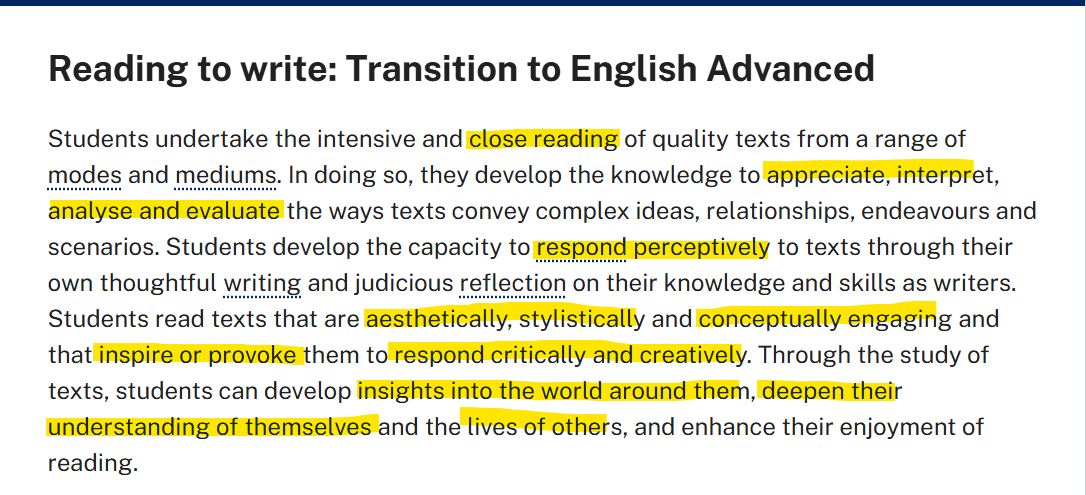
The Band 6 Formula: What the Rubric Really Means
The rubric boils down to three big skills:
1. Close Reading
Look beyond what is said to how it’s said — imagery, figurative language, structure, tone, word choice.
These details reveal deeper meaning and give you tools to use in your own writing.
2. Interpretation & Evaluation
Bring your own ideas to the text. Let them be challenged.
Your personal insights matter — how a text makes you feel is part of the analysis.
3. Creative + Critical Response
Use what you’ve learned to shape your own writing.
Think about the author’s techniques and experiment with them.
Writers have always “stolen” what works — you’re joining a long tradition.
It’s all here in black and white (but mostly black):
Mastering the Module
To succeed, you need to shift from reader to investigator:
Examine how language creates emotion and meaning
Notice how texts reflect different cultures, eras and perspectives
Analyse the beauty and craft behind the writing
Apply those techniques to your own work
This cycle — read → reflect → write → revise — helps you see the world with “literary eyes” and express your ideas with clarity, creativity and confidence.